Recovery used to mean rest days and foam rollers. Now the greater Chicago area has 74 dedicated recovery studios offering everything from infrared sauna to hyperbaric oxygen to NAD+ drips — and the global fitness recovery market has hit $8.2 billion, growing at 11.8% annually in the US alone.
But here's the thing: not all modalities are backed by the same quality of evidence, and not every modality is right for every person. This guide breaks down 10 recovery modalities available across Chicago — what the peer-reviewed research actually says, what happens in your body during a session, and who each one is best for.
No marketing claims. Just the science.
Recovery Studios by Modality — Chicago Area
Before we dig into the research, here's the landscape. These are the 74 validated recovery studios we've mapped across greater Chicago, broken down by what they offer:
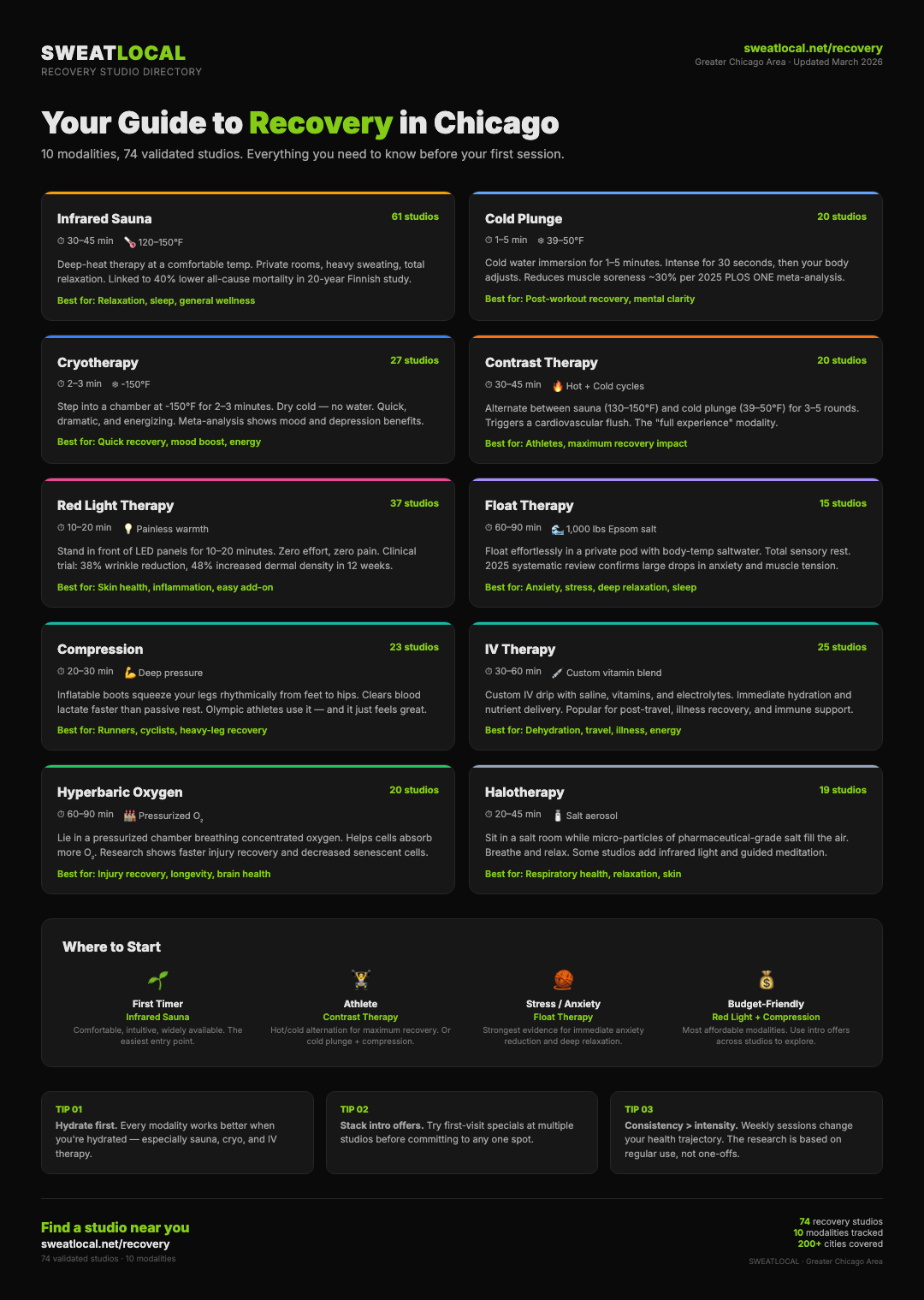
1. Infrared Sauna
61 studios in Chicago · 30–45 min
Unlike traditional saunas that heat the air to 180°F+, infrared saunas use light panels to heat your body directly at 120–150°F. You sweat heavily but breathe comfortably.
What the research says: The Finnish Kuopio Heart Study — a 20-year study of 2,315 people published in JAMA Internal Medicine — found that people who used a sauna 4+ times per week had a 40% lower risk of all-cause mortality and a 63% lower risk of sudden cardiac death compared to once-a-week users. A follow-up study in BMC Medicine (2018) including both men and women confirmed these findings.
What happens in your body: Core temperature rises 2–3°F, triggering heat shock proteins that repair damaged cells. Heart rate increases to 100–150 bpm — comparable to moderate exercise. Blood vessels dilate, improving circulation. 83% of regular users report improved sleep lasting 1–2 nights after a session.
Best for: Sleep quality, general wellness, cardiovascular health. The broadest appeal of any modality — a good entry point if you're new to recovery.
Browse all 61 infrared sauna studios →
2. Cold Plunge
20 studios in Chicago · 1–5 min
You step into a tub of water cooled to 39–50°F and stay for 1–5 minutes. The first 30 seconds are intense. After that, you adjust — and when you step out, you feel an endorphin rush and mental clarity that can last for hours.
What the research says: A January 2025 systematic review in PLOS ONE (11 studies, 3,177 participants) found that cold water immersion at 50–59°F reduces muscle soreness by ~30% at 24–72 hours post-exercise. A separate 12-week study showed significantly lower cortisol levels after just four weeks of regular cold exposure. Stanford Lifestyle Medicine research suggests cold exposure may prime the nervous system with stress-coping mechanisms through "neurohormesis" — a controlled stress that strengthens neural resilience.
What happens in your body: Norepinephrine surges 200–300%, driving alertness and focus. Blood vessels constrict, then rapidly dilate when you exit — flushing inflammation. Vagal tone improves, shifting your nervous system toward parasympathetic recovery.
Best for: Post-workout recovery, mental clarity, stress resilience. The modality with the most social media momentum right now — and the science actually backs it up.
Browse all 20 cold plunge studios →
3. Cryotherapy
27 studios in Chicago · 2–3 min
Whole-body cryotherapy puts you in a chamber cooled to -150°F or below for 2–3 minutes. You wear minimal clothing — shorts, socks, gloves. The dry cold feels intense but it's over quickly.
What the research says: A 2021 meta-analysis found that whole-body cryotherapy is an effective add-on intervention for improving mood and reducing depressive symptoms, with participants reporting reduced anxiety and better quality of life after 10-session protocols. For athletic recovery, cryotherapy shows benefits similar to cold water immersion for reducing perceived muscle soreness.
What happens in your body: Skin temperature drops rapidly, triggering a systemic anti-inflammatory response. Endorphins and adrenaline spike. Unlike cold plunge (water transfers heat 25x faster than air), the dry cold in cryotherapy feels more manageable for most people — higher throughput, lower intimidation factor.
Best for: Quick recovery between workouts, mood boost, people who want cold therapy but prefer it dry. Also see: Cryo vs. Cold Plunge vs. Contrast Therapy.
Browse all 27 cryotherapy studios →
4. Contrast Therapy
20 studios in Chicago · 30–45 min
You alternate between hot (infrared sauna at 130–150°F) and cold (cold plunge at 39–50°F) in timed intervals — typically 3–5 rounds of 3 minutes hot, 1–2 minutes cold. The contrast triggers a cardiovascular flush that accelerates recovery.
What the research says: Contrast water therapy research shows improved lactate clearance and reduced perceived fatigue compared to passive recovery. The alternating vasodilation (heat) and vasoconstriction (cold) creates a "pumping" effect that moves blood and lymphatic fluid more efficiently than either temperature alone.
What happens in your body: Blood vessels dilate during heat, constrict during cold — a mechanical pump that flushes metabolic waste. Heart rate variability improves. Most people describe contrast therapy as the most "alive" they've felt after a wellness session. It's the modality most likely to make you a regular.
Best for: Athletes, anyone wanting maximum recovery impact in one visit. Often considered the "full experience" at multi-modality studios.
Browse all 20 contrast therapy studios →
5. Red Light Therapy
37 studios in Chicago · 10–20 min
You stand or lie in front of panels emitting red (660nm) and near-infrared (850nm) light for 10–20 minutes. It's completely painless — you'll feel gentle warmth, nothing more.
What the research says: A 2023 clinical trial showed 38% wrinkle reduction, 48% increased dermal density, and 24% improved skin firmness after 12 weeks of twice-weekly treatment. For muscle recovery, a 2024 study in the Journal of Biophotonics demonstrated improved muscle function in a randomized, triple-blind, sham-controlled trial. A 2024 umbrella review of randomized clinical trials confirmed benefits for pain reduction, inflammation, and tissue repair.
What happens in your body: Red and near-infrared photons penetrate 2–7cm into tissue and are absorbed by cytochrome c oxidase in your mitochondria — the enzyme that drives ATP (cellular energy) production. More ATP means faster cell repair, reduced oxidative stress, and lower inflammation. Near-infrared (850nm) penetrates deeper into muscle and joints; visible red (660nm) targets skin.
Best for: Skin health, inflammation, post-workout recovery. The easiest modality to add to any routine — sessions are short and require zero effort.
Browse all 37 red light therapy studios →
6. Float Therapy
15 studios in Chicago · 60–90 min
You float in a private pod or room filled with body-temperature water and 1,000+ pounds of Epsom salt — so dense you float effortlessly. Sessions last 60–90 minutes in complete darkness and silence.
What the research says: A 2025 systematic review of flotation-REST literature (1960–2024) confirmed that floating produces large, immediate drops in anxiety, muscle tension, and perceived stress, along with increased serenity and relaxation. A 2024 randomized controlled trial with 75 adults with anxiety and depression found six float sessions to be safe, well-tolerated, and effective. Floating also significantly lowered blood pressure and increased heart rate variability.
What happens in your body: Sensory input drops to near-zero, allowing your nervous system to shift into deep parasympathetic mode. Magnesium from the Epsom salt absorbs through your skin, supporting muscle relaxation and sleep. Blood pressure decreases. Many people fall asleep — that's normal and encouraged.
Best for: Anxiety, stress, deep relaxation, sleep improvement. The most immersive recovery experience available — and the one with the highest per-session satisfaction.
Browse all 15 float therapy studios →
7. Compression Therapy
23 studios in Chicago · 20–30 min
You slip into inflatable boots (like NormaTec) that sequentially squeeze your legs from feet to hips, flushing out metabolic waste and improving circulation. It feels like a deep, rhythmic massage.
What the research says: Research shows NormaTec boots clear blood lactate significantly faster than passive recovery. A 2015 study with 25 Olympic athletes found reduced muscle pain after hard training when incorporating intermittent compression. The biggest finding? The perceived recovery benefit is enormous — participants consistently report that compression "just feels good."
What happens in your body: Sequential pneumatic compression mimics the muscle pump that occurs during walking — but more aggressively. Fluid moves from your extremities back toward your core, reducing swelling and flushing metabolic byproducts. It's the most passive modality — you sit there while the machine works.
Best for: Runners, cyclists, anyone with heavy legs after training. Pairs well with sauna or cold plunge as part of a recovery circuit.
Browse all 23 compression therapy studios →
8. Hyperbaric Oxygen Therapy
20 studios in Chicago · 60–90 min
You lie inside a pressurized chamber breathing concentrated oxygen for 60–90 minutes. The increased pressure dissolves more oxygen into your plasma than normal breathing allows.
What the research says: A 2024 study showed elite athletes recovered faster from injuries with HBOT. A 2025 double-blind randomized trial demonstrated meaningful improvements in persistent brain injury symptoms. Recent clinical trials highlight HBOT's ability to decrease senescent (aging) cells, increase elastic fiber length, and enhance collagen density — essentially slowing biological aging at the cellular level.
What happens in your body: At 1.3–2.0 ATA pressure, blood plasma oxygen saturation increases 10–15x above normal. This hyper-oxygenated blood reaches tissues that are hypoxic (oxygen-starved) due to injury or inflammation. Stem cell release increases. Angiogenesis (new blood vessel formation) is stimulated. It's the most clinical of the recovery modalities.
Best for: Injury recovery, post-concussion, long COVID symptoms, longevity protocols. Sessions are usually recommended in multi-session protocols rather than one-offs.
Browse all 20 hyperbaric oxygen studios →
9. IV Therapy
25 studios in Chicago · 30–60 min
A registered nurse inserts a small IV line and you relax for 30–60 minutes while a customized blend of saline, vitamins, and electrolytes drips directly into your bloodstream. Popular blends target hydration, energy, immunity, or post-event recovery.
What the research says: IV hydration provides rapid fluid and electrolyte replenishment — bypassing the GI tract means nearly 100% bioavailability compared to 20–40% for oral supplements. The clinical evidence is strongest for acute dehydration and nutrient deficiency correction. For the "wellness drip" category (Myers' cocktail, glutathione, high-dose vitamin C), the research is earlier-stage but patient-reported outcomes are consistently positive.
What happens in your body: Fluids and nutrients enter your bloodstream immediately, bypassing digestion entirely. Cells rehydrate faster than drinking water. B-vitamin complexes and magnesium support energy production and muscle function. You'll typically feel effects within 30–60 minutes of the drip starting.
Best for: Post-travel, post-event, dehydration, illness recovery. The modality with the most immediately noticeable effects.
Browse all 25 IV therapy studios →
10. Float + Halotherapy (Salt Therapy)
19 studios in Chicago · 20–45 min
You sit in a salt room while a halogenerator disperses pharmaceutical-grade dry salt aerosol into the air. The micro-particles are inhaled and also settle on your skin. Many studios combine salt rooms with infrared light or guided meditation.
What the research says: Halotherapy proponents cite benefits for respiratory conditions (asthma, allergies, sinusitis), skin health (eczema, psoriasis), and general relaxation. The evidence base is growing but more limited than the modalities above. A 2014 study found improved lung function in patients with mild asthma after salt room sessions. It's the most meditative recovery modality available.
What happens in your body: Dry salt particles (1–5 microns) reach deep into the bronchial system, where they absorb moisture and thin mucus. Anti-inflammatory properties help reduce airway irritation. Salt on the skin may support the dermal microbiome and help with inflammatory skin conditions.
Best for: Respiratory health, relaxation, skin conditions. A gentle entry point that pairs well with sauna or red light. Lowest intimidation factor of any modality.
Browse all 19 halotherapy studios →
Session Duration at a Glance
Where to Start: 4 Personas, 4 Paths
The Newcomer — Never tried recovery before? Start with infrared sauna. It's comfortable, widely available (61 studios), affordable, and intuitive — you sit in a warm room and sweat. Zero intimidation factor. Find one near you →
The Athlete — Training hard and need faster bounce-back? Go straight to contrast therapy (hot/cold alternation) or a cold plunge + compression combo. These have the most direct impact on muscle recovery and soreness reduction. Browse contrast therapy studios →
The Stress Case — Wired, can't sleep, running on cortisol? Float therapy has the strongest evidence for immediate anxiety reduction. If float tanks feel too claustrophobic, infrared sauna is your backup — 83% of regular users report improved sleep. Browse float therapy studios →
The Optimizer — Already into wellness and want to go deeper? Try cryotherapy first (quick, dramatic), then layer in red light therapy and explore hyperbaric oxygen for the longevity angle. Multi-modality studios let you stack sessions in a single visit. Browse the full directory →
Find Your Studio
We've mapped and validated every dedicated recovery studio in the greater Chicago area — 74 centers across 15 modalities. Every listing includes services offered, pricing when available, ratings, and intro offers.